Every year, tens of thousands of Australian students in Years 3, 5, 7, and 9 sit the National Assessment Program – Literacy and Numeracy (NAPLAN). For many primary students and their families, the Language Conventions section—which directly measures spelling, grammar, and punctuation—generates the most apprehension. Yet with the right preparation strategies, NAPLAN spelling can become a confident opportunity rather than an intimidating obstacle.
Preparing effectively for NAPLAN spelling does not require drilling hundreds of isolated flashcards or copying endless word lists until hands hurt. Instead, research shows that students who understand how words work—through sound patterns (phonology), word parts (morphology), and origin rules (etymology)—achieve markedly higher retention and lower anxiety.
Understanding the NAPLAN Spelling Format
A common surprise for parents is that NAPLAN does not conduct spelling tests the way traditional Friday classroom tests do. Rather than dictating a word for students to spell, the NAPLAN Language Conventions test typically presents two types of questions:
- Identify and Correct: A sentence contains a deliberate misspelling, either circled or underlined. The student must write or type the correct spelling into an answer box.
- Multiple Choice: Students select which sentence among four options contains a spelling error, or choose the correct spelling among four distractors.
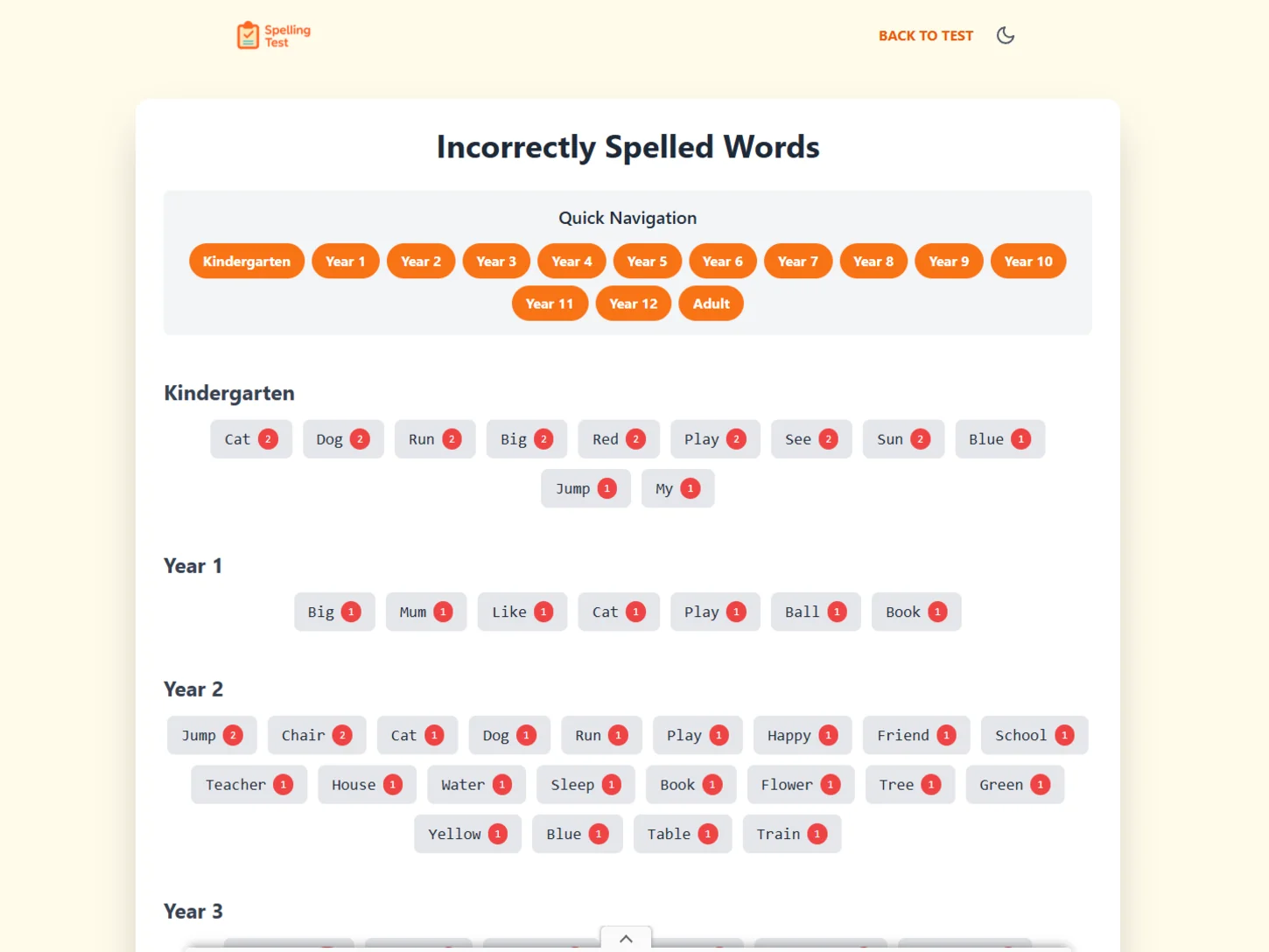
Because students must spot errors within full sentences, context and reading comprehension play a critical role. Practising spelling with an interactive digital tool like Spelling Test Australia bridges this exact gap: learners hear the word pronounced in natural Australian English, read it in a complete example sentence, and type their answer with immediate feedback.
Key Spelling Focus Areas: Year 3 vs. Year 5
What to Expect in Year 3 NAPLAN Spelling
Year 3 marks the first time Australian children sit formal national assessments. Under the Australian Curriculum (v9.0), Year 3 spelling questions focus heavily on:
- Common Vowel Digraphs and Teams: Mastering patterns such as ea (beach, heavy), oa (boat), ai / ay (train, clay), and oi / oy (coin, enjoy).
- Consonant Blends and Digraphs: Accurate discrimination of ch, sh, th, wh, and ending clusters like -tch (catch) and -dge (bridge).
- Basic Inflectional Endings: Applying doubling rules before adding -ed or -ing (hop → hopping, hope → hoping) and changing y to i (happy → happily).
- High-Frequency Sight Words: Commonly used irregular words like friend, because, could, through, and people.
What to Expect in Year 5 NAPLAN Spelling
By Year 5, questions shift from purely phonetic recall to morphological understanding. Students are assessed on:
- Complex Prefixes and Suffixes: Understanding how affixes modify root words without losing critical letters (e.g., dis- + satisfied = dissatisfied, un- + natural = unnatural).
- Silent Letters: Deciphering historical silent combinations like kn- (knight), wr- (wrist), -mb (climb), and -gn (gnome).
- Greek and Latin Stems: Words built from roots like tele- (distance), photo- (light), tract (pull), and struct (build).
- Tricky Homophones: Differentiating confusing pairs such as affect / effect, principle / principal, dessert / desert, and practice / practise (noun vs. verb in Australian English).
4 Practical Steps to Prepare Without Anxiety
1. Build Typing and Screen Familiarity
Because NAPLAN is delivered via the NAP online platform, handwriting alone is no longer sufficient. A student who spells words perfectly on paper can still score lower if they struggle to locate keys on a keyboard or make typographical errors under timed conditions. Doing weekly online practice runs on Spelling Test ensures typing fluency matches spelling ability.
2. Teach the "Sound, Meaning, Letter" Check
When students encounter an unfamiliar word, train them to avoid pure guessing. Instead, teach this three-step mental strategy:
- Sound Check: How many syllables does the word have? What are the individual vowel sounds?
- Meaning Check: Does this word share a root with a simpler word? (e.g., magician comes from magic; signature comes from sign).
- Letter Check: Which rule applies? (e.g., "i before e except after c", or "drop the e before adding -ing").
3. Keep Revision Sessions Under 15 Minutes
Cramming 50 words the weekend before NAPLAN causes cognitive overload and heightens anxiety. High-performing students consistently practice in short, focused bursts—10 to 15 minutes three times a week. Spacing practice over weeks establishes durable long-term orthographic mapping in the brain.
4. Focus on Error Analysis Rather Than Test Scores
When an answer is incorrect, celebrate the learning opportunity. Look at the error together: "You spelled 'necessary' with two c's. Here is a helpful mnemonic: a shirt has one Collar (c) and two Sleeves (ss)." Breaking down tricky words turns mistakes into permanent breakthroughs.
"The goal of NAPLAN preparation is not to drill test answers, but to give children the tools to decode any word they encounter with confidence."