BENEFITS OF USING SPELLING TEST TO PREPARE FOR SCHOOL SPELLING TESTS
May 01, 2026
SPELLING TEST INCORRECT WORDS LIST
HOW SPELLING SKILLS IMPACT READING COMPREHENSION IN EARLY CHILDHOOD
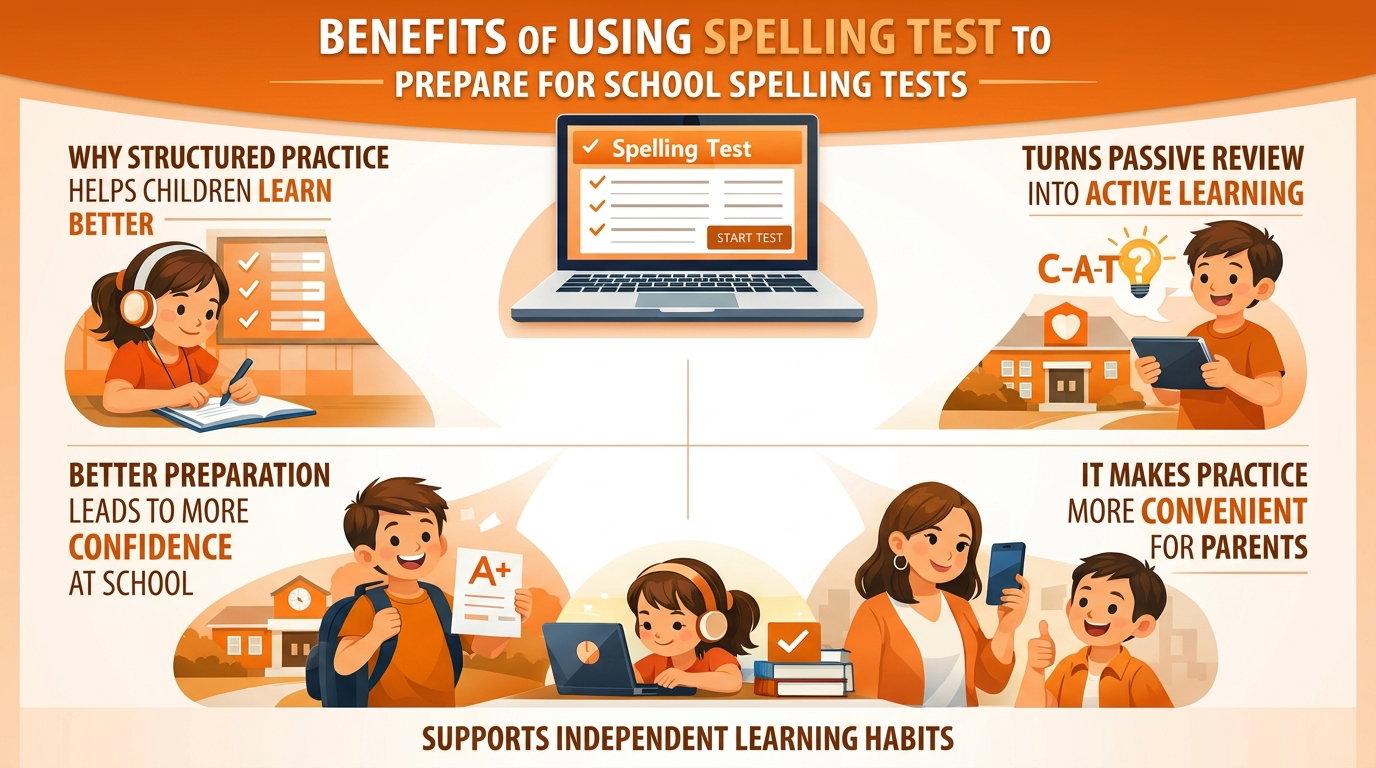
School spelling tests can feel simple on the surface, but for many children and families they can quickly become a weekly source of stress, last minute cramming, forgotten word lists, and disappointment when the results do not match the effort. That is exactly why using an online spelling tool in a consistent and practical way can make such a big difference. A platform like Spelling Test gives students a structured, repeatable, and encouraging way to prepare before the classroom test arrives, and that preparation does much more than help a child memorise a few words for Friday. It can build confidence, improve recall, support reading and writing, and create a calmer routine for parents and teachers who want something that is effective without becoming complicated.
When children prepare for spelling tests using a purpose built tool rather than only reading words from a sheet of paper, they get a more active learning experience. They are not just looking at words and hoping they stick in memory. Instead, they hear the words, type them, check their answers, repeat difficult items, and gradually strengthen the connection between sound, spelling, and meaning. That matters because spelling is not only about passing a school task. It is part of literacy, and literacy supports almost every other area of learning.
In this article, I want to look closely at the real benefits of using Spelling Test to prepare for school spelling tests, especially from the perspective of students, parents, and teachers who want a simple and supportive way to improve results over time. While every child learns differently, the right tool can make practice more engaging, more consistent, and far more useful than rushed revision the night before a test.
WHY STRUCTURED PRACTICE HELPS CHILDREN LEARN BETTER
One of the biggest advantages of using a dedicated spelling platform is that it turns spelling practice into a structured activity instead of an irregular guessing game. In many homes, spelling preparation happens only when someone remembers to do it, and even then it may involve reading a list out loud, covering the words, and hoping for the best. That method can work for some children, but it often lacks consistency, and consistency is one of the most important parts of learning. Spelling improves when students practise regularly, notice their mistakes, and get repeated exposure to words in a manageable format.
With an online spelling tool, practice becomes easier to repeat because the process is already set up. Students can work through their words in a familiar way each time. That routine reduces friction. Instead of needing a parent to sit down with a pen and paper every session, a child can often start independently or with minimal help. This makes it more likely that practice will actually happen, which is often the hidden factor behind better school results. A simple routine done regularly is usually more effective than a perfect routine done only occasionally.
Structured practice also helps children feel less overwhelmed. A long list of words on paper can look intimidating, especially for younger learners or students who already doubt their spelling ability. When those same words are presented one at a time in a guided format, they feel more manageable. The child can focus on the current word rather than worry about the whole list. That small shift can reduce resistance and help the student stay engaged for longer.
IT TURNS PASSIVE REVIEW INTO ACTIVE LEARNING
Another major benefit of using Spelling Test is that it encourages active learning. Passive review happens when a child simply reads over a word list several times without needing to retrieve the spelling from memory. It may feel like study, but it often creates a false sense of confidence because recognising a word is much easier than spelling it correctly from scratch. Active learning is different. It asks the learner to listen, think, recall, and produce the answer. That process is more demanding, but it is also much more effective.
When students hear a word and then type it, they are training recall rather than recognition. This strengthens memory pathways in a more durable way. It also mirrors what happens in many school spelling tests, where the student hears the word and has to write it independently. In other words, the practice format becomes more closely aligned with the actual task. That kind of preparation is valuable because the child is not just learning the words, but also getting comfortable with the testing process itself.
Active learning also reveals gaps quickly. A child may think they know how to spell because, separate, or important when they see the words on a page, but once asked to type them from memory, the uncertainty becomes clear. That is not a bad thing. In fact, it is one of the best parts of meaningful practice. Mistakes show where more attention is needed, and once those weak points are visible, the student can improve more efficiently.
BETTER PREPARATION LEADS TO MORE CONFIDENCE AT SCHOOL
Confidence matters far more than many people realise. Children who walk into a spelling test feeling prepared tend to approach the task with a calmer mind and better focus. Children who feel unprepared often second guess themselves, rush, panic, or give up on words they might actually know. A tool like Spelling Test can support confidence by making preparation feel clear and achievable rather than stressful and uncertain.
Confidence grows when children see evidence of improvement. If they can practise a list several times and notice that they are getting more answers right, they begin to trust their own ability. That feeling carries into the classroom. Instead of seeing the weekly spelling test as something to fear, they may begin to see it as something they can handle. For some students, that emotional shift is just as important as the spelling gains themselves.
This is especially helpful for children who have had a few disappointing spelling results and have started telling themselves that they are simply bad at spelling. Once a child adopts that identity, motivation often drops. A supportive online practice tool can help break that pattern because it gives them a low pressure space to improve before they are assessed at school. Small wins during practice can gradually rebuild trust in their own learning.
IT MAKES PRACTICE MORE CONVENIENT FOR PARENTS
Parents are often willing to help with spelling practice, but real life can get in the way. Work schedules, dinner, homework from other subjects, after school activities, and general tiredness can make it difficult to sit down every week and manually test a child on their word list. This is one of the most practical reasons a site like Spelling Test is useful. It reduces the setup and supervision needed to get meaningful practice done.
Instead of a parent needing to read every word aloud, correct each answer, and keep track of progress, the platform handles much of that process. That does not remove the parent from learning altogether, but it does make the task less demanding. Parents can still offer encouragement, help with difficult words, and monitor improvement, while the tool takes care of the repetitive mechanics. This is particularly valuable in families with multiple children or busy evening routines.
Convenience matters because when something is easier to do, it gets done more often. That sounds obvious, but it is one of the most powerful drivers of real educational progress. A tool does not have to be complicated to be useful. In fact, for school spelling preparation, simple and reliable is often exactly what families need.
IMMEDIATE FEEDBACK HELPS CHILDREN CORRECT MISTAKES FASTER
Feedback is one of the most important ingredients in learning, and timing matters. When children make a spelling mistake and find out straight away, they have a better chance of noticing the difference between what they wrote and what is correct. If too much time passes, the learning opportunity weakens. Spelling Test can help by providing immediate feedback, which allows students to adjust quickly instead of repeating the same error again and again.
This matters because many spelling mistakes are not random. They often follow patterns. A child may consistently leave out a silent letter, confuse vowel combinations, or reverse parts of longer words. Once those patterns become visible, the child and parent can focus on the real issue rather than treating every wrong answer as a separate problem. Immediate correction helps students become more aware of their habits, and awareness is the first step to improvement.
Fast feedback can also make practice feel more rewarding. Children do not have to wait until the end of a long session to know how they went. They can see progress in real time. For some learners, that instant response helps maintain motivation because it turns practice into an interactive experience rather than a delayed judgement.
REPETITION BUILDS STRONGER MEMORY WITHOUT FEELING BORING
Spelling improvement depends heavily on repetition, but repetition only works when students are willing to keep doing it. Traditional methods sometimes make repetition feel dull because the child is copying the same word list over and over without much variation or engagement. A digital spelling tool can make repeated practice feel lighter and more purposeful. The child is still revisiting the same words, but in a format that feels more active and easier to continue.
Repeated exposure is especially useful for tricky words that do not follow obvious phonetic rules or that contain letter patterns children often miss. Seeing, hearing, and typing these words across multiple sessions helps move them from short term memory towards longer term recall. That is a much better outcome than memorising just enough to scrape through one weekly test and then forgetting the words days later.
Good repetition also creates familiarity under pressure. A word that looked difficult at the start can begin to feel normal after several successful attempts. That sense of familiarity is powerful because it reduces hesitation during the actual school test. Instead of feeling like they are meeting a difficult word for the first time, the child feels that they have already handled it before.
IT CAN HELP REDUCE TEST ANXIETY
School spelling tests are low stakes in one sense, but to a child they can still feel very important. Some students become anxious before tests because they fear getting words wrong in front of classmates, disappointing a teacher, or bringing home a poor score. Anxiety can interfere with recall even when the child has studied. That means a student who knows the words at home may still underperform at school if nerves take over.
Using Spelling Test as part of a regular weekly routine can help reduce this anxiety because it makes the test format feel familiar. The child practises hearing words and responding to them. They experience mistakes privately during preparation rather than publicly during assessment. Over time, the classroom test may start to feel less threatening because it resembles something they have already done many times in a safe environment.
Routine is calming for many children. When they know what to expect each week, they often feel more in control. Instead of last minute panic, there is a sense that preparation is underway and progress is being made. Even if a child is not perfect on every word, the knowledge that they have practised properly can make them feel more settled going into the test.
IT BENEFITS DIFFERENT TYPES OF LEARNERS
Children do not all learn spelling in exactly the same way. Some are strong visual learners who remember the shape of words. Some respond better to hearing words spoken aloud. Others need to type or write words repeatedly before they stick. One of the strengths of an online spelling platform is that it can support several learning modes at once. Students can see the word, hear the word, and actively enter the word, which creates a more rounded learning experience.
This is particularly helpful when a child has struggled with one method alone. For example, a student who gets little out of silently reading a word list may perform much better when there is an audio cue and an interactive response. Another child might benefit from repeating words across several short sessions rather than one long revision block. The flexibility of online practice makes it easier to find a rhythm that suits the learner.
For parents, this can be encouraging because it removes the pressure to invent the perfect teaching method at home. The goal does not need to be turning the kitchen table into a classroom. Instead, the aim is to give the child a practical system that increases exposure, encourages recall, and makes learning easier to repeat.
IT STRENGTHENS THE LINK BETWEEN SPELLING, READING, AND WRITING
It is easy to think of weekly spelling tests as isolated school tasks, but spelling ability affects much more than test scores. Children who improve their spelling often become more confident readers and writers as well. When they recognise word patterns more easily, reading can become smoother. When they know how to spell common and challenging words more reliably, writing becomes less interrupted by hesitation and guesswork.
That means the benefits of using Spelling Test can extend beyond the next classroom assessment. Every word a child learns properly becomes part of their usable vocabulary. They are more likely to notice that word in books, understand it in context, and use it correctly in their own writing. Over time, this contributes to stronger literacy skills overall.
Better spelling can also support writing fluency. Children who constantly stop to wonder how a word is spelled may lose momentum in their ideas. They might choose simpler words just to avoid mistakes. As spelling knowledge grows, writing can become more expressive because the child is not held back by uncertainty on every second sentence. That is a valuable long term gain that often begins with simple weekly practice.
TEACHERS CAN RECOMMEND A TOOL THAT FITS REAL HOME ROUTINES
From a teacher perspective, one challenge with homework based spelling preparation is that not every family has the same amount of time, confidence, or capacity to run practice sessions manually. A simple online spelling tool can be a helpful bridge because it gives families a clearer way to support school learning at home. Teachers do not need to rely solely on paper lists and hope that every child gets equal quality practice.
When a tool is straightforward and accessible, it is more likely to be used consistently across different households. That matters because a good support tool should reduce barriers rather than create new ones. If parents can quickly understand how their child should practise, and if students can use the platform without a lot of confusion, then home learning becomes more realistic and sustainable.
Teachers may also appreciate that a digital tool encourages more frequent revision without requiring them to design complex extra materials. The simpler the process, the easier it is for families to stick with it week after week. In education, practical tools are often the most valuable because they support real behaviour rather than ideal plans that never happen.
SHORT PRACTICE SESSIONS OFTEN WORK BETTER THAN LONG ONES
One common mistake with spelling revision is trying to do too much in one sitting. Long study sessions can lead to fatigue, frustration, and reduced focus, especially for younger students. A platform like Spelling Test fits well with shorter and more regular practice blocks, which tend to be more effective for memory and much easier to fit into everyday life.
Ten focused minutes across several days can produce better results than one rushed forty minute session the night before the test. Short sessions allow the brain to revisit the words multiple times without overload. They also make practice feel achievable. If a child believes the task will be quick and manageable, they are less likely to resist it.
This is one of the quiet strengths of digital learning tools. They lower the effort required to begin. When there is no need to organise papers, call out words manually, and mark answers by hand, it becomes easier to squeeze in a useful practice session after school, before dinner, or during another small window of time. That flexibility can turn inconsistent revision into a regular habit.
USING THE RIGHT TOOL CAN MAKE LEARNING FEEL ENCOURAGING INSTEAD OF PUNISHING
Children learn better when practice feels supportive rather than punishing. If spelling is always associated with correction, disappointment, or pressure, motivation can drop quickly. A warm and accessible platform can help shift that emotional tone. Instead of spelling practice feeling like a weekly reminder of what the child gets wrong, it can become a space where they improve, repeat, and succeed at their own pace.
This does not mean removing challenge. Children still need to work through difficult words and notice mistakes. But challenge works best when it is paired with encouragement and a clear pathway to improvement. A simple online tool is useful because it gives students another chance immediately. A wrong answer is not the end of the process. It is part of the process.
That mindset is important. When children understand that mistakes are expected and correctable, they become more willing to keep practising. This supports resilience as much as spelling. In the long run, the child who keeps trying and refining will usually make stronger progress than the child who avoids practice because they fear getting things wrong.
THE BENEFITS GO BEYOND THE NEXT TEST SCORE
It is natural for parents and students to focus on the next school spelling test because that is the immediate goal, but the real value of effective practice is broader than one score on one day. Using Spelling Test regularly can help children build confidence, stronger study habits, better recall, and a more positive relationship with words. It can make home revision easier for families, create less stress around weekly preparation, and support literacy skills that reach into reading and writing as well.
What makes this especially worthwhile is that the approach is simple. Children do not always need more pressure, more worksheets, or more complicated systems. Often they just need a clear, repeatable, and supportive way to practise. When a spelling tool helps them hear words, type them, review mistakes, and try again, it gives them a realistic way to prepare for school while building skills that last beyond the classroom test.
For parents, teachers, and students looking for a practical way to make spelling practice more effective, using Spelling Test can be a smart step. It helps turn preparation from something rushed and frustrating into something regular, manageable, and genuinely useful, and that is often where better learning begins.
WHO IS SPELLING TEST FOR?
BENEFITS OF USING SPELLING TEST TO PREPARE FOR SCHOOL SPELLING TESTS