HOW SPELLING SKILLS IMPACT READING COMPREHENSION IN EARLY CHILDHOOD
June 11, 2026
BENEFITS OF USING SPELLING TEST TO PREPARE FOR SCHOOL SPELLING TESTS
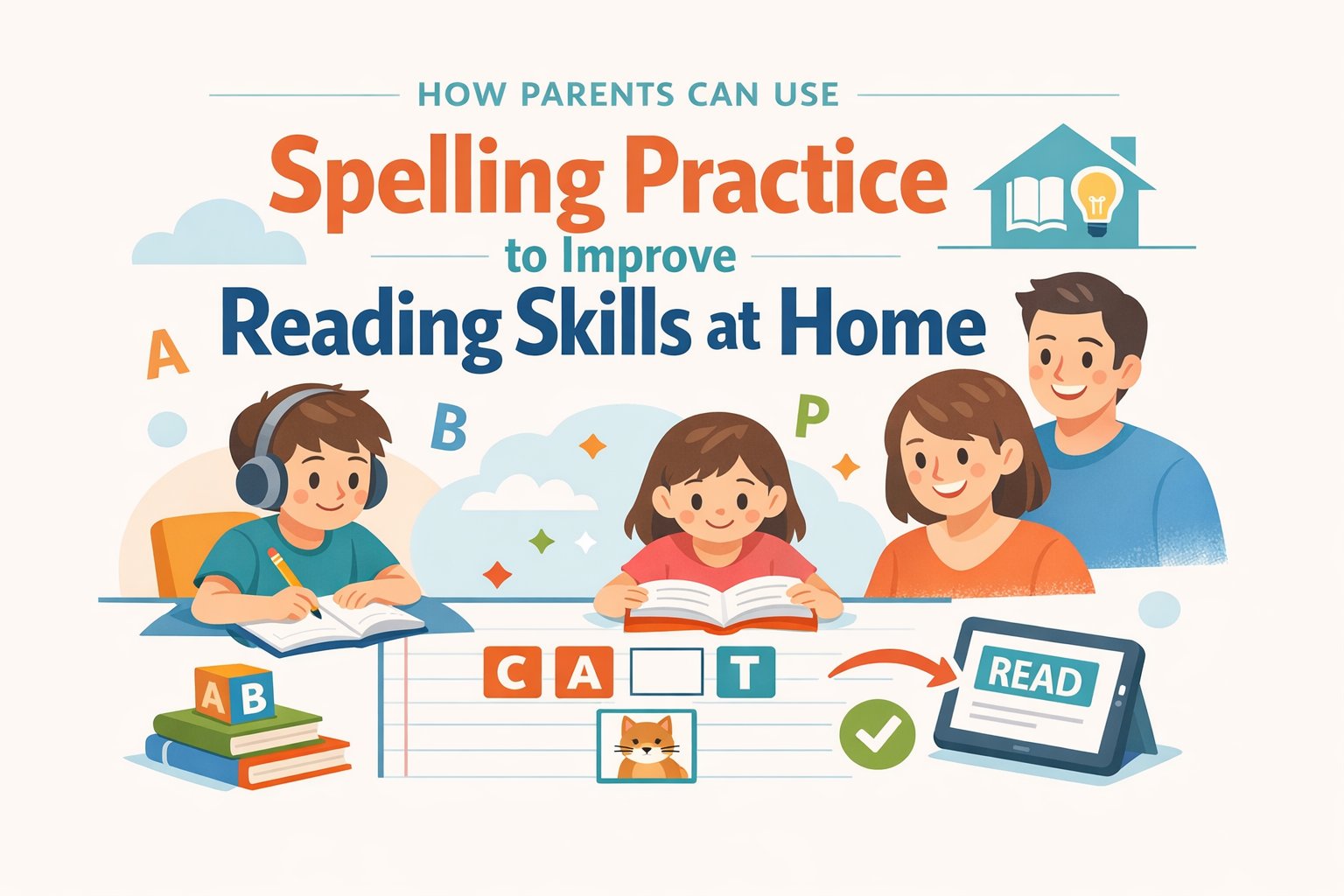
When a child is learning to read, it can be tempting to treat spelling as a separate homework task. Reading happens in books, spelling happens on a weekly list, and comprehension happens when a child answers questions about a story. In reality, these skills are deeply connected. A child who understands how words are built is usually better prepared to recognise those words, read them fluently, and understand what they mean in a sentence.
For parents and teachers of children aged five to ten, this connection matters. Early literacy is not only about getting through readers or memorising spelling lists. It is about helping children build a strong word knowledge system in their brain. Spelling practice, when done well, strengthens that system. It helps children notice sounds, letters, patterns, meanings, and word families. Over time, this makes reading feel less like a guessing game and more like a confident, meaningful process.
This is especially important in the early primary years, when children are moving from sounding out simple words to reading longer sentences, richer stories, and more complex classroom texts. The stronger their spelling knowledge becomes, the more brain power they can use for comprehension, imagination, discussion, and learning.
In this article, we will look at why spelling skills have such a powerful impact on reading comprehension, how the reading and writing connection works, what orthographic mapping means in simple terms, and how parents can support spelling at home without turning it into a nightly battle.
Spelling and Reading Are Two Sides of the Same Coin
Reading and spelling may look like opposite tasks, but they rely on the same underlying knowledge. When children read, they decode. That means they look at letters and letter patterns, connect them to sounds, and blend those sounds into words. When children spell, they encode. That means they hear or think of a word, break it into sounds, and choose the letters or letter patterns that represent those sounds.
Decoding and encoding work together. A child who can read the word shop needs to recognise that the letters s, h, o, and p work together to represent the sounds in the word. A child who can spell shop needs to understand the same sound and letter relationships, just in the other direction.
This is why spelling practice can improve reading. When a child writes a word, says the sounds, notices the letter choices, and checks the spelling, they are not simply memorising a sequence. They are strengthening the same mental pathways they need for reading.
For example, learning to spell rain, train, paint, and wait helps a child notice that ai can represent a long vowel sound. Once that pattern is familiar, the child is more likely to recognise similar words when reading. Instead of stopping and guessing, they can use what they know about spelling to read more smoothly.
This matters because fluent reading is not just fast reading. Fluent reading means the child can recognise words accurately and automatically enough to pay attention to meaning. Spelling supports this because it teaches children how words are put together.
Why Word Knowledge Builds Reading Confidence
Children often lose confidence in reading when too many words feel unfamiliar. They may pause frequently, guess from pictures, skip words, or become frustrated before they reach the meaning of the text. Strong spelling knowledge helps reduce that frustration.
When children practise spelling in a thoughtful way, they learn that words are not random. English can be complex, but it does have patterns. Children begin to see that words can be grouped by sound, spelling pattern, syllable type, meaning, and word origin. This gives them tools.
A child who knows the spelling pattern in cake may be more prepared to read make, take, and snake. A child who understands that ed can mark past tense may make better sense of words like jumped, looked, and played. A child who learns the difference between there, their, and they're is also learning how spelling carries meaning.
This growing word knowledge gives children more control. Instead of seeing each word as a separate item to memorise, they start to build a mental map. That map supports reading accuracy, spelling accuracy, vocabulary, and comprehension.
How Spelling Supports Vocabulary and Meaning
Reading comprehension depends heavily on vocabulary. Children need to know what words mean, but spelling can also help them understand how words relate to one another.
Many English words contain meaningful parts. These include base words, prefixes, and suffixes. When children learn to spell these parts, they also learn clues to meaning.
For example:
- happy, unhappy, and happiness are related in meaning.
- play, played, and playing show changes in tense and form.
- help, helpful, and helpless show how suffixes can change meaning.
When children see these relationships, they become better at working out unfamiliar words. If a child knows the word kind and understands the suffix ness, they are more likely to understand kindness in a story. If they can spell care, careful, and careless, they begin to see how spelling and meaning work together.
This is one reason spelling should not be limited to rote memorisation. A child might memorise because for a test, but deeper learning happens when they explore sound patterns, tricky parts, word meanings, and usage in sentences.
How Digital Tools Can Make Spelling Less Stressful
Parents are busy. Teachers are managing full classrooms. Children have different learning needs, attention spans, and confidence levels. This is where a thoughtful digital tool can help.
An interactive spelling platform such as Spelling Test can make spelling practice easier to manage because it supports children with audio, personalised word lists, and progress tracking. Instead of relying only on paper lists, children can hear words clearly, practise at their own pace, and receive support as they learn.
For parents, this reduces the pressure of having to run every practice session manually. For teachers, it can provide a more efficient way to support different learners. For children, it can make spelling feel more like a guided activity than a punishment.
The goal is not to replace parent or teacher involvement. The goal is to remove friction. When practice is easier to start, easier to repeat, and easier to track, children are more likely to build the consistent habits that improve reading over time.
Practical Ways to Practise Spelling at Home
Spelling practice at home does not need to be complicated. The best routines are short, calm, and predictable. Here are three stress free ways to support your child.
1. Use the Say, Tap, Write, Read Routine
Choose one word from your child's list. Ask your child to say the word aloud. Then ask them to tap the sounds they hear on their fingers. After that, they write the word while saying each sound or spelling pattern. Finally, they read the word in a sentence.
For example, with the word float:
- Say the word: float.
- Tap the sounds: f, l, oa, t.
- Write the word while noticing oa.
- Read a sentence: The leaf can float on the water.
This routine connects speech, sound, spelling, writing, and meaning. It only takes a minute or two per word, but it builds strong connections.
2. Sort Words by Pattern
Instead of practising words in random order, ask your child to sort them into groups. They might sort by vowel pattern, beginning sound, ending, syllable count, or meaning.
For example, a child might sort these words:
- rain, paint, train
- day, play, stay
Both groups contain a long vowel sound, but the spelling pattern is different. This helps children notice that one sound can be represented in more than one way. That awareness supports both spelling and reading.
3. Practise Words in Real Sentences
A spelling word becomes more useful when a child can read it and use it in context. After practising a word, ask your child to create a sentence with it. Keep it fun and personal.
If the word is garden, your child might write: Dad found a blue lizard in the garden. If the word is because, they might write: I wore my jumper because it was cold.
This step links spelling to meaning. It also helps children prepare for reading, because words in books do not appear as isolated list items. They appear in sentences, paragraphs, and stories.
How Teachers Can Strengthen the Spelling and Comprehension Link
In the classroom, spelling instruction can support reading comprehension when it is explicit, systematic, and connected to real texts. Children benefit when teachers explain patterns clearly rather than expecting them to discover every rule by chance.
Useful classroom practices include:
- Teaching spelling patterns directly: Show children how a pattern works, then practise with multiple examples.
- Connecting spelling to reading groups: Highlight spelling patterns that appear in the books children are reading.
- Using dictation: Ask children to write words and sentences that include current spelling patterns.
- Reviewing older patterns: Revisit previous learning so children retain it.
- Discussing word meaning: Link spelling with vocabulary and comprehension.
For example, if a class is learning the igh pattern, they might read words such as night, light, and bright, spell them, use them in sentences, and find them in a shared text. This creates multiple pathways into learning.
When spelling is taught in isolation, children may not see its purpose. When it is connected to reading and writing, they begin to understand that spelling is a tool for communication.
Common Signs That Spelling May Be Affecting Reading Comprehension
Parents and teachers may notice clues that weak spelling knowledge is making reading harder. These signs do not always mean there is a serious problem, but they can show that a child needs more support with word patterns and decoding.
- The child reads very slowly and becomes tired quickly.
- The child guesses words from the first letter rather than reading through the word.
- The child can read a page aloud but struggles to explain what happened.
- The child avoids reading or says reading is too hard.
- The child spells the same word many different ways.
- The child has difficulty remembering common high frequency words.
- The child struggles with words that share similar patterns.
If you notice these signs, respond with encouragement rather than pressure. Many children need repeated, structured practice before spelling patterns become automatic. The aim is to build confidence and skill together.
What About Children Who Can Read But Struggle to Spell?
Some children appear to read well but still find spelling difficult. This can happen because reading and spelling are connected but not identical. Spelling often requires more precise recall. When reading, a child may recognise a word from context. When spelling, they must produce the correct letters in the correct order without seeing the word.
This does not mean spelling is less important. In fact, spelling practice can still strengthen reading by deepening the child's knowledge of word structure. It can also improve writing confidence. Children who struggle to spell may avoid using interesting vocabulary in their writing because they are worried about making mistakes.
Support these children by focusing on patterns, not just errors. Instead of saying, That is wrong, try asking, Which part of the word is tricky? or What pattern could help us remember this? This keeps the conversation constructive and helps the child become a word detective.
Keeping Spelling Practice Positive
Children learn best when they feel safe, capable, and supported. If spelling practice becomes a nightly argument, the emotional load can get in the way of learning. A calm routine is more effective than a long session filled with frustration.
Try these simple principles:
- Keep sessions short: Five to ten minutes can be enough for young children.
- Celebrate effort: Praise careful thinking, not just perfect scores.
- Focus on one pattern at a time: Too many rules at once can overwhelm children.
- Use mistakes as clues: Errors show what the child is still learning.
- Review gently: Repetition matters, but it can be light and encouraging.
A child who feels successful is more likely to keep practising. Over time, that practice builds the automatic word recognition that supports stronger reading comprehension.
Why Early Support Matters
The early primary years are a crucial time for literacy development. Children are building the foundation they will use across every subject. Reading is needed for maths problems, science texts, history topics, digital learning, and everyday life. When spelling supports reading, it supports learning more broadly.
Early support can prevent small gaps from becoming larger ones. If a child misses key spelling patterns, they may find later reading tasks more difficult. On the other hand, when children build strong word knowledge early, they are better prepared for more complex texts in upper primary years.
This does not mean every child must progress at the same pace. Children develop differently. Some need more repetition. Some need more audio support. Some need visual examples. Some need movement and hands on practice. The key is to provide consistent, structured, and encouraging opportunities to connect sounds, letters, words, and meaning.
How Spelling Test Can Help
Spelling Test is designed to make spelling practice more manageable for families and classrooms. With interactive practice, audio support, and personalised tracking, it helps children practise words in a way that is clear and accessible.
For parents, it can remove some of the stress from homework routines. For teachers, it can support regular practice and progress monitoring. For children, it offers a simple way to hear, practise, and review words without feeling overwhelmed.
Most importantly, a tool like Spelling Test can help turn spelling from a once a week memory challenge into a regular literacy habit. That habit can support reading fluency, word recognition, vocabulary growth, and comprehension.
If your child is finding spelling or reading difficult, small steps can make a real difference. Start with a few words. Talk about the sounds. Notice the patterns. Use the words in sentences. Read them in books. Then revisit them again later.
Spelling is not just about correct letters on a page. It is a key part of how children learn to read with confidence and understanding. When children learn to spell, they strengthen the connections between sounds, letters, patterns, and meaning. Those connections help words become familiar, reduce cognitive load, and free the brain to focus on comprehension.
For parents and educators, the message is encouraging. You do not need to make spelling practice long, stressful, or complicated. Short, thoughtful practice can have a lasting impact. By helping children understand how words work, you are also helping them become stronger readers.
And when children read with less struggle, they can focus on the best part of reading: discovering ideas, enjoying stories, asking questions, and making meaning.
Ready to make spelling practice easier? Visit Spelling Test and try a simple, interactive way to support your child's spelling and reading journey.
Frequently Asked Questions
- How does spelling help children with reading comprehension?
- Spelling helps children understand how words are built from sounds, letters and patterns. When children can recognise words more accurately and automatically, they have more mental energy available to focus on meaning, story details and classroom learning.
- Are reading and spelling separate skills?
- No. Reading and spelling are closely connected. Reading involves decoding words from letters to sounds, while spelling involves encoding words from sounds to letters. Both skills rely on the same knowledge of letter patterns, sounds and word meanings.
- What is orthographic mapping?
- Orthographic mapping is the process the brain uses to store written words in long-term memory. When children connect the sounds in a word to the letters that represent them, they become more likely to recognise that word quickly when reading.
- Why is spelling practice important in the early primary years?
- Children aged five to ten are developing the word knowledge they need for fluent reading. Strong spelling skills help them notice patterns such as vowel teams, word endings and word families, making it easier to read longer sentences and more complex texts.
- How can parents support spelling at home without causing stress?
- Parents can make spelling practice short, positive and meaningful. Instead of only memorising lists, children can say the sounds in words, look for spelling patterns, group similar words together and use new words in sentences. This helps spelling feel connected to real reading and writing.
WHO IS SPELLING TEST FOR?
HOW SPELLING SKILLS IMPACT READING COMPREHENSION IN EARLY CHILDHOOD