SPELLING TEST INCORRECT WORDS LIST
March 07, 2026
WHO IS SPELLING TEST FOR?
BENEFITS OF USING SPELLING TEST TO PREPARE FOR SCHOOL SPELLING TESTS
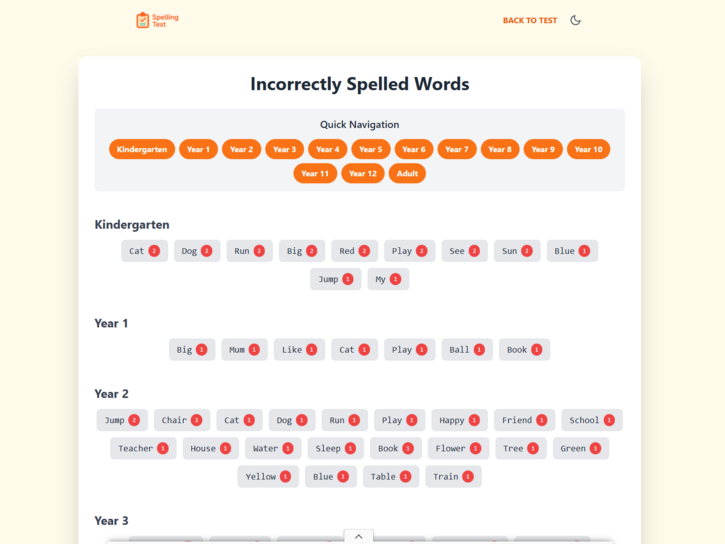
If you are helping children improve their spelling, or you are an adult trying to sharpen your own written English, one of the most useful things you can look at is a list of words that people commonly get wrong. That is exactly why the Incorrect Words page on Spelling Test is so practical. It gives a clear view of the words users are struggling with across different year levels and among adults, which makes it easier to spot patterns, revise weak areas, and focus on the words that matter most.
In this post, I want to go through why the Incorrect Words Spelling list is useful, who it helps, and how you can use it as a simple learning tool at home, in class, or for your own personal study. I will also mention a new feature we added that makes the list much more interactive. Users can now click on words in the list and listen to the definition, along with hearing the word used in a sentence. That makes the page much more than just a list. It becomes a practical revision tool.
If you want to explore it yourself, you can check the page here: https://app.spellingtest.au/incorrect-words
Why an incorrect words list matters
A spelling test is useful because it measures performance, but the real value often comes after the test. Once a learner knows which words they missed, they can focus on improvement. An incorrect words list takes that idea and scales it across a wider group of users. Instead of only seeing one person’s mistakes, you can see the words that many people in different year levels and adults are getting wrong.
That is powerful for a few reasons.
First, it highlights the words that are genuinely challenging. Some words trip people up because of silent letters. Some are difficult because they sound like another word. Others are easy to say but hard to write correctly. When the same words keep appearing on an incorrect list, it usually means there is something about them that deserves more attention.
Second, it helps learners feel less discouraged. If a child sees that other students also struggle with the same spelling, it can reduce the feeling that they are failing alone. The problem is not always effort. Sometimes the word itself is simply tricky.
Third, it helps parents and teachers work smarter. Instead of guessing which words need revision, they can use real data from the list. This saves time and helps direct practice towards the most common weak spots.
What the Incorrect Words page shows
The Incorrect Words page on Spelling Test brings together words that users have commonly answered incorrectly. One of the best things about it is that it is not limited to one narrow age group. It shows mistakes being made by learners across different year levels, as well as adults.
That means the page can be useful for several types of users:
- Parents supporting children with weekly spelling homework
- Teachers looking for common spelling problem words
- Students who want extra revision material
- Adults improving spelling for work, study, or everyday writing
What I like about this approach is its simplicity. You are not looking at abstract theory. You are looking at real words people are actually getting wrong. That makes the page more practical than a generic spelling advice article. It gives you something immediate to work on.
Common spelling mistakes happen at every age
One thing that stands out when you look at incorrect spelling lists is that spelling difficulty does not disappear completely with age. Yes, younger learners will often make more mistakes as they build vocabulary and learn spelling rules, but adults also get words wrong, especially words that are less common, irregular, or easy to confuse.
This is important because people often assume spelling mistakes are only a children’s issue. In reality, adults still run into trouble with words in emails, reports, forms, social media posts, and professional communication. A useful spelling platform should support both school age learners and adults, and the Incorrect Words page reflects that idea well.
There are many reasons why adults still misspell words:
- Some words are not used often enough to become automatic
- Pronunciation does not always match spelling
- Some words have unusual letter patterns
- Fast typing can lead to repeated mistakes
- People rely too much on autocorrect and do not fully learn the correct form
Seeing adults included on the list makes the page feel more realistic and more useful. It reminds everyone that spelling is a skill that can always be improved.
How the list helps different year levels
Children in different year levels are usually dealing with different spelling challenges. A younger student may still be learning basic sound to letter relationships, while an older student may be dealing with more advanced vocabulary, exceptions to spelling rules, and subject specific words.
An incorrect words list helps because it lets you see where those challenge points might be appearing. For example, some year levels may struggle more with vowel combinations, while others may struggle with longer words, suffixes, or words borrowed from other languages.
For parents, this can give a better idea of what to revise. Instead of simply repeating a school list without much context, they can compare that with broader patterns and identify words that deserve extra attention.
For teachers, it can help with lesson planning. If certain words are showing up repeatedly as incorrect, they may be worth revisiting in class through dictation, sentence writing, reading practice, or word analysis.
For students, the benefit is very direct. They can review words that are not just random, but proven to be difficult for many learners at a similar stage.
Patterns behind commonly incorrect words
When you spend time looking at spelling mistakes, you begin to notice patterns. Most incorrect words are not random. They often fall into a few familiar categories.
Words with silent letters
Words with letters that are not pronounced are classic troublemakers. Learners may write the word exactly as it sounds and leave out the silent letter.
Words with double letters
One of the most common issues is remembering whether a word uses one consonant or two. This can affect confidence because the word may look almost right while still being incorrect.
Homophones and similar sounding words
Words that sound the same or very similar can easily be confused, especially in quick writing. Learners may know the sound but choose the wrong spelling.
Irregular words
English is full of words that do not follow simple phonetic rules. These words often need repeated exposure and memory based practice.
Longer academic or formal vocabulary
Older students and adults often struggle with more advanced words that appear in reading, school assignments, or workplace communication.
The value of the Incorrect Words page is that it helps make these patterns visible. Once you understand the kinds of words people are getting wrong, you can build more effective revision strategies around them.
New feature: click a word and listen to the definition and sentence usage
One of the best updates we have added to the Incorrect Words list is a new interactive feature. Users can now click on the words on the list and listen to the definition, as well as hear the usage of the word in a sentence.
This makes a big difference.
A plain list of incorrect words is already useful, but this new feature turns the page into a much richer learning experience. Instead of only seeing a difficult word, users can now hear more context around it. That matters because spelling is not only visual. It is also connected to sound, meaning, and usage.
Here is why this feature is so helpful:
- It supports auditory learners who remember information better by hearing it
- It helps users understand what the word actually means
- It shows how the word is used naturally in context
- It can reduce confusion between similar words
- It makes independent study easier and more engaging
For children, hearing a word used in a sentence can help them connect it to something meaningful rather than treating it like an isolated spelling challenge. For adults, hearing the definition can quickly clarify whether they are thinking of the correct word or mixing it up with another one.
This feature also makes revision smoother at home. A parent does not always need to explain every word manually. The learner can click, listen, and review with more independence.
Why meaning and usage improve spelling
There is a strong link between understanding a word and spelling it correctly. When a learner knows what a word means and how it is used in a sentence, the word becomes more memorable. It is no longer just a string of letters. It becomes part of a meaningful example.
For instance, if someone hears a word in context, they can better distinguish it from similar sounding words. If they hear the definition, they can anchor the spelling to the correct concept. This is especially useful for words that are commonly confused.
That is why the clickable audio feature is more than a nice extra. It supports deeper learning.
In practical terms, this can help users:
- Remember difficult words for longer
- Use words more accurately in writing
- Improve reading comprehension at the same time
- Build vocabulary while practising spelling
It is a simple addition, but it makes the Incorrect Words page much more useful for regular revision.
How parents can use the Incorrect Words list at home
If you are a parent, the page can be used in a very practical way without needing to create a complicated study plan.
One simple method is to choose a small number of words each week. Focus on quality rather than quantity. Ask your child to look at the word, click to hear the definition and sentence, then write the word down a few times. After that, ask them to use the word in their own sentence.
You can also turn it into a short routine:
- Read the word together
- Click to listen to the definition
- Listen to the sentence usage
- Talk about what the word means
- Write the word from memory
- Check and correct it if needed
This process combines listening, understanding, speaking, and writing. That is far more effective than rote copying on its own.
Another benefit is that the list gives you ideas when your child says they have no words to practise. Instead of searching for random examples online, you can use words that have already been shown to be difficult for many learners.
How teachers can use it in the classroom
For teachers, the Incorrect Words page can be a useful support resource rather than just an interesting list. It can help identify trends, create warm up activities, and guide revision tasks.
Some simple classroom uses include:
- Choosing weekly focus words from commonly misspelled entries
- Building sentence writing exercises around difficult words
- Using the audio feature for group listening and discussion
- Creating mini quizzes based on commonly incorrect words
- Comparing similar words and discussing why people confuse them
Because the words reflect real mistakes, students may find the tasks feel more relevant. They are not being tested on obscure items for no reason. They are working on words that people genuinely struggle with.
The page could also be useful for intervention support. If a student repeatedly struggles with certain spelling patterns, a teacher can use the list as a source of targeted examples.
How adults can use the page to improve spelling confidence
Adults often want practical tools that do not feel childish or overly academic. The Incorrect Words page works well because it is direct and easy to use. You can browse words, identify problem areas, and now click to hear definitions and sentence usage without needing a complicated setup.
This can be especially useful if you want to improve spelling for:
- Work emails and reports
- Job applications and CV writing
- Study and assignments
- Everyday digital communication
- General self improvement
A good approach for adults is to keep a personal error notebook. When you notice a word you often get wrong, add it to your list. Then use the Incorrect Words page to find similar words and review them too. Click to hear the definition and sentence, then type or write the word yourself a few times in context.
Spelling confidence usually improves through repeated correct exposure. The page supports that process in a very accessible way.
Simple ways to study incorrect words effectively
If you want better results from the list, here are a few straightforward methods that work well.
Use small batches
Do not try to memorise too many words at once. Pick five to ten words and work through them properly.
Listen before writing
Use the new feature to hear the definition and sentence before attempting the spelling. This builds context first.
Say the word aloud
Speaking the word can help reinforce sound patterns and memory.
Write the word in a sentence
This helps link spelling with actual usage rather than isolated repetition.
Review regularly
Words are easier to retain when revisited over time instead of crammed once.
Focus on error patterns
If you often miss silent letters, double consonants, or endings, pay extra attention to those features.
These methods are simple, but when paired with a real world incorrect words list, they become much more effective.
Why this fits the idea of simple, practical learning
What I like most about the Incorrect Words page is that it follows a simple and practical approach. It does not overwhelm users with too much theory. It gives them something useful straight away: a list of words people are actually getting wrong, organised in a way that can support learning across ages.
The added click to listen feature improves that even further. It takes the page from being informative to being interactive. You are no longer just scanning a list. You are hearing the word’s meaning and hearing it used naturally in a sentence, which helps with memory, understanding, and confidence.
That is often the best kind of educational tool. Not flashy for the sake of it. Just genuinely useful.
Final thoughts
The Spelling Test Incorrect Words list is a smart resource for anyone who wants to understand which words learners and adults are commonly getting wrong. It is useful because it focuses on real mistakes, not guesses. That makes it practical for parents, teachers, students, and adults who want to improve their spelling.
The most important update is the new feature that lets users click on words in the list and listen to the definition, as well as hear the word used in a sentence. That extra context makes the list much more helpful for learning and revision. It supports understanding, pronunciation, memory, and correct usage all at once.
If you are looking for a simple but effective way to work on difficult spellings, this page is well worth a look. You can explore it here:
https://app.spellingtest.au/incorrect-words
Sometimes the fastest way to improve is not to study everything. It is to focus on the words people are actually getting wrong, understand why they are difficult, and practise them with the right support. This page does exactly that.
WHO IS SPELLING TEST FOR?
SPELLING TEST INCORRECT WORDS LIST